
The letter that started the saga is SAA 16 28, also known as the “Princess, Do Your Homework!” letter. When I first posted in on Twitter, my hope was to popularise letters other than Nanni’s complaint tablet to Ea-nasir. While Ea-nasir remains the most famous recipient of an Akkadian letter in pop culture, the “Princess, Do Your Homework!” letter ignited a trend in which Assyriologists across the platform posted their favourite letters. Just as well! Here it is.
Our two main characters are Libbāli-šarrat, the primary wife of Assurbanipal, and Šeruʾa-eṭirat, her sister in law. In the present letter, Libbāli-šarrat is reprimanded by Šeruʾa-eṭirat to do her homework, i.e., practice her literacy by writing and reading her tablets. Not at all a pleasant topic – but the illiteracy of a queen was no laughing matter!
SAA 16 28
| Transliteration | Translation | |
|---|---|---|
| a-bat dumu.mí-lugal a-na | Word of the king’s daughter to | |
| mí.uru.šà-uru-šar-rat | Libbāli-šarrat | |
| a-ta-a ṭup-pi-ki la ta-šaṭ-ṭi-ri | Why do you not write your tablets (and why) | |
| im.gíd-ki la ta-qab-bi-i | Do you not say your liginnu? | |
| 5 | ú-la-a i-qab-bi-ú | If (you do) not, they will say: |
| ma-a an-ni-tu-u nin-sa | “Is this the sister | |
| rev. | ša mí.dedin-e-ṭè-rat | “Of Šeruʾa-eṭirat, |
| dumu.mí.gal-tú ša é-uš-meš-te | “The oldest daughter of the Succession Palace | |
| ša maš-šur-nir.gál-dingir.meš-gin-in-ni | “Of Aššur-etel-ilāni-mukinni | |
| man gal man dan-nu man šú man kur.aš-šur | “The great king, mighty king, king of the world, king of Assyria?” | |
| r.5 | ù at-ti ma-rat kal-lat gašan-é ša maš-šur-dù-a | Yet you are (only) a daughter-in-law, lady of the house of Aššur-bani-apli, |
| dumu-man gal ša é-uš-meš-te | The great crown prince designate | |
| ša maš-šur-pab-aš man kur.aš | Of Aššur-aḫu-iddina, king of Assyria! |
Translated and adapted from ORACC: https://oracc.museum.upenn.edu/saao/P334196 (accessed 24.11.24) & Luuko, Mikko & Greta van Buylaere. 2002. The Political Correspondence of Esarhaddon (State Archives of Assyria XVI). Helsinki: Helsinki Univeristy Press. p.23.
Šeruʾa-eṭirat was remarkable in that she appeared to hold a high rank at the Assyrian court, outranking not only her sister-in-law, as suggested in the present letter, but also several of her brothers (Teppo 2007: 394).
A little bonus, not previously shared on Twitter, is this sketch of Libbāli-šarrat by A. Billerbeck from 1867. The sketch is based of a relief in Niniveh, and was originally published in F. Delitzsch in Babel und Bibel 3, fig. 28 (Leipzig, 1903). The screenshot is taken from Luuko & van Buylaere (2002: 22).
I like to imagine Libbāli-šarrat sitting in her chambers with her ladies in waiting attending to her as the messenger reads out this letter to her. The reaction must have been comical. “What a b****!”
References:
Luuko, Mikko & Greta van Buylaere. 2002. The Political Correspondence of Esarhaddon (State Archives of Assyria XVI). Helsinki: Helsinki Univeristy Press.
Teppo, Saana. 2007. Agency and the Neo-Assyrian Women of the Palace. Studia Orientalia Electronica 101. 381–420.
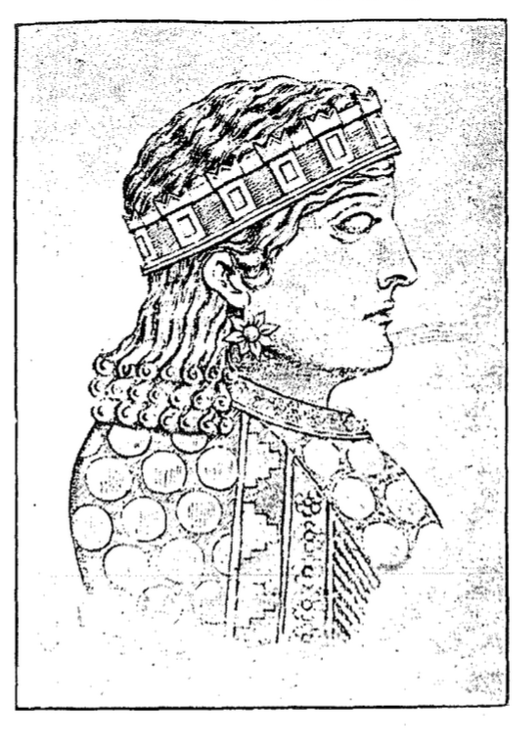
Libbāli-šarrat. (Luuko & van Buylaere 2002: 22.)
 Iris Tanza-Kamil